
Digital Twins to support the implementation of Positive Energy Districts
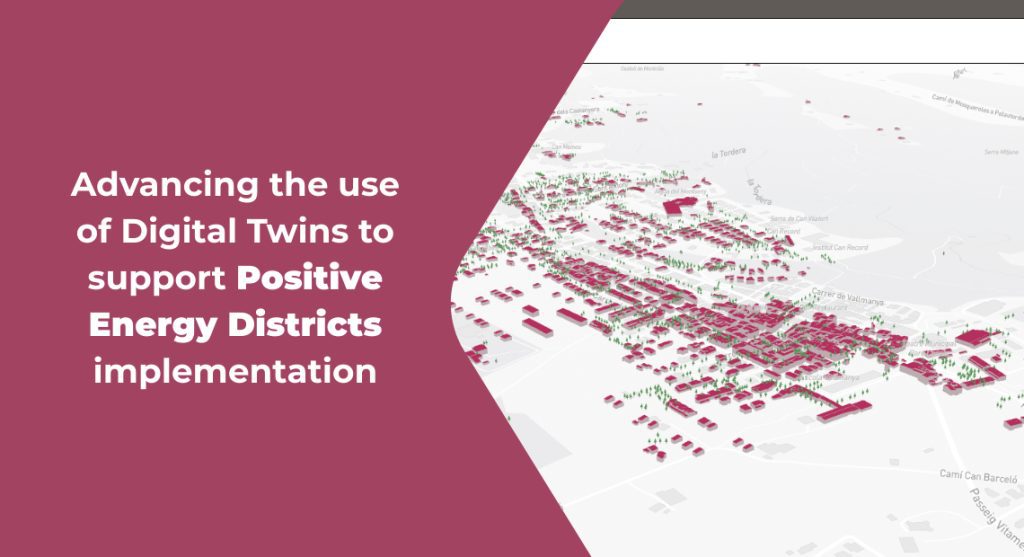
Designing climate-neutral neighbourhoods and districts requires reliable and comprehensive data that is aligned with urban city strategies for climate neutrality. Digital Twins have emerged as essential tools, supporting visualization, informed decision-making and stakeholder participation in the transformation of urban areas into complex environments.
In this context, the Scale-UP MAKING PEDs project aims to support Positive Energy District (PED) implementation across urban areas, addressing both neighbourhood specific and city-wide applications, by developing data-driven Digital Twins. The project will integrate reliable, local data across urban systems, enhance cross-sector modelling and establish decentralized governance models, engaging stakeholders in the co-design and optimisation of climate-neutral districts and helping cities align local actions with long-term sustainability and climate neutrality goals.
Building on the results of the ongoing MAKING PEDs project, Scale-UP Making PEDs will test and validate its approaches in five Urban Living Labs located in Linz (Austria), Bærum (Norway), Civitavecchia and Grottaferrata (Italy) and Sant Esteve de Palautordera (Spain). These pilot cases will provide diverse perspectives, enabling knowledge transfer and the replication of successful strategies across diverse urban contexts. In addition, the project will deliver guidelines, training materials and best practices to facilitate replication and scaling in other cities.
The Scale-UP MAKING PEDs project has a total budget of over 1,6M€ and will run for almost 3 years. The consortium is formed by IREC (the coordinator), Cíclica, the Municipality of Sant Esteve de Palautordera, the Norwegian University of Science and Technology (NTNU), the Municipality of Bærum, the University of Roma Tre, the Municipality of Grotafferrata, Lazio Innova, ATER Civitavecchia, UFGC GmbH, Austrian Institute of Technology (AIT) , and the city of Linz.
IREC is responsible for the management and coordination of the project. As for the technical activities, it will be in charge of expanding energy models to include centralized/decentralized heating and cooling, district energy networks and electricity grids; looking for interoperable and data information of 3D models in CityGML; and defining outputs for visualization and testing of tools and supporting activities in the Spanish Urban Living Lab.
Acknowledgements (in Spanish)
Actuación PCI20251671202, financiada por MICIU/AEI/10.13039/50110001033 y por la Unión Europea, en su caso, siendo PCI20251671202 la referencia que figura en la resolución de concesión; MICIU el acrónimo del Ministerio de Ciencia, Innovación y Universidades; AEI el acrónimo de la Agencia Estatal de Investigación; y 10.13039/501100011033 el DOI (Digital Object Identifier) de la Agencia.
